
The Fokker C.XIV-W
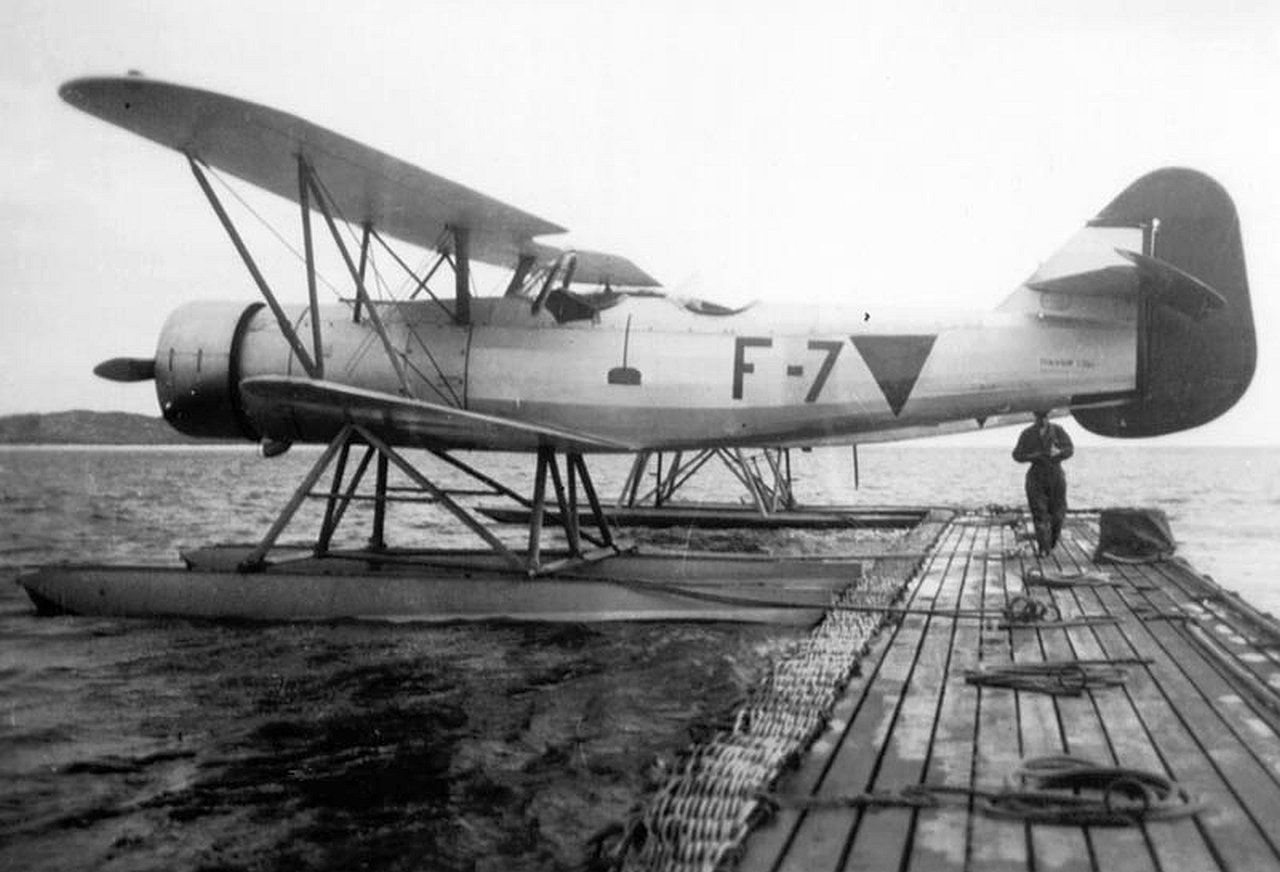
In 1938, the Netherlands Naval Aviation Service ordered no fewer than 24 light reconnaissance seaplanes from Fokker.
They could serve as trainers and were also used to replace the C.VII-W.
The aircraft were equipped with dual controls, although in practice the second set was often removed.
The C.XI-W aircraft were catapult-launched long-range reconnaissance seaplanes, whereas the C.XIV-W did not operate from ships.
Its structure and engine were considerably lighter than those of the C.XI-W.
The engine used was a 425–450 hp Wright Whirlwind.
Maximum speed 230 km/h. Cruise speed 198 km/h. Empty weight 1,320 kg. Take-off weight 1,952 kg.
Length 9.5 m. Height 4.25 m. Wing area 31.4 m2.
Ceiling 5,400 m. Range 950 km.
The two machine guns (one fixed forward-firing gun on the left of the engine and one behind the second cockpit) fired at two different rates.
The forward 7.9 mm machine gun fired 250 rounds per minute; the rear 7.9 mm gun fired 500 rounds per minute.
The fixed forward-firing machine gun was mounted behind the engine on the left. The rear machine gun, behind the second cockpit, was movable.
Click the photo to enlarge




Information about the crates of which we do not have a photo.
The tailplanes of all C.XIV-W reconnaissance aircraft no longer had the red, white, and blue livery; that became orange after all.
An important factor was also that there was great urgency in the deliveries, and certainly in the recording of data and photos.
That is why conflicting information is sometimes available regarding which scouts were destroyed in the Netherlands and in the Dutch East Indies, and when.
The F-3 with c/n 5589 was delivered on May 5, 1939, and stationed at MVK Alkmaarder Meer.
During the departure via France to England, the F-3 remained behind in Calshot near Southampton in England.
There it became the tank tug (also called a target tug) for shooting exercises.
On March 1, 1941, the F-3 was retired after years of service.
On November 29, 1939, c/n 5609 is delivered as F-17 at Marine Air Base (MVK) Veere and departs on May 14, 1940, via France to England.
Subsequently shipped to the Dutch East Indies and destroyed at Morokrembangan in March 1942.
On December 6, 1939, c/n 5610 is delivered as F-18 on MVK Alkmaarder Meer and departs on May 14, 1940, via France to England.
Subsequently shipped to the Dutch East Indies and destroyed at Morokrembangan in March 1942 during the Japanese invasion.
C/n 5595 was delivered to Alkmaarder Meer or Veere on August 28, 1939 as F-20.
On January 10, 1940, fired upon by a French ship off the coast of Scheveningen, despite its orange livery.
Repaired and on May 13, 1940 on Alkmaarder Meer but damaged again or near Veere.
Apparently good enough for a flight via France to England and shipped to the Dutch East Indies on the MVK Morokrembangan, destroyed.
(Here, too, there is uncertainty regarding whether the destruction took place in the Dutch East Indies or in the Netherlands.)
With c/n 5596, the F-21 delivered
It was completely destroyed during a German attack on Veere Airfield on May 12, 1940.
With c/n 5597, it is also delivered to MVK Alkmaarder Meer on August 28, 1939, as F-22.
The F-22 proves repairable after a brief incident on May 12, 1940, with a Junkers Ju-88.
On May 14, 1940, the F-22 joined the group departing via France to England.
There, the reconnaissance aircraft was shipped to the Dutch East Indies and eventually destroyed on Morokrembangan in March 1942.
(Here, too, there is talk of the possible crash of the F-22 due to the Ju-88 incident).
C/n 5598 is delivered on 30 Aug 1939 as F-23 at MVK Veere and manages to escape on May 14, 1940.
From there via France to England and shipped to the Dutch East Indies, and destroyed in March 1942.
The last of the series is c/n 5599, delivered 14 Sep. 1939 as F-24 at Marine Air Base Veere.
The reconnaissance aircraft was completely destroyed during the Ju-88 incident on May 12, 1940, and cannot be repaired.
THIS WOULD BE THE LAST AIRCRAFT OF THE MANY C-RECONNAISSANCE AIRCRAFT BUILT AT FOKKER.
We would like to receive some more information about the C.XIV-W, perhaps from the Naval Air Service. Thank you in advance.
Below is a short list of the history of the F-8 through the F-15, due to a lack of photos and limited information in connection with the approaching war.
- The F-8 had c/n 5600 and was delivered on September 14, 1939, to Naval Air Base (MVK) De Mok.
It would not be the last bombing, because on May 12, 1940, De Mok airfield was struck again. - F-9 c/n 5601 delivered 31 Oct. 1939, destroyed on 12 May 1940 during the bombing of MVK De Mok on Texel.
- F-10 '5602 '1 Nov 1939 ' on May 12, 1940 during the bombing of MVK De Mok.
- F-11 '5603' '17 Oct 1939' on May 12, 1940 during the bombing of MVK De Mok.
- F-12 '5604' 17 Oct 1939 on 2 May 1940 during the bombing of MVK De Mok.
- F-13 '5605' Nov 1, 1939, light damage, Alkmaarder Meer on 12.05.1940, shipped to the Dutch East Indies via France and England on 14 May 1940, destroyed in March 1942.
- F-14 '5606' 1 Nov 1939 destroyed on 12 May 1940 during the bombing of MVK De Mok on the island of Texel.
- F-15 '5607' 16 Nov 1939 escaped on 14 May 1940 shipped to the Dutch East Indies via France and England, destroyed in March 1942