
Fokker biographies
Anthony Fokker's life story as a book, feature film, comic strip, play, documentary, audiobook, and television series. A chronological overview of his biographies.
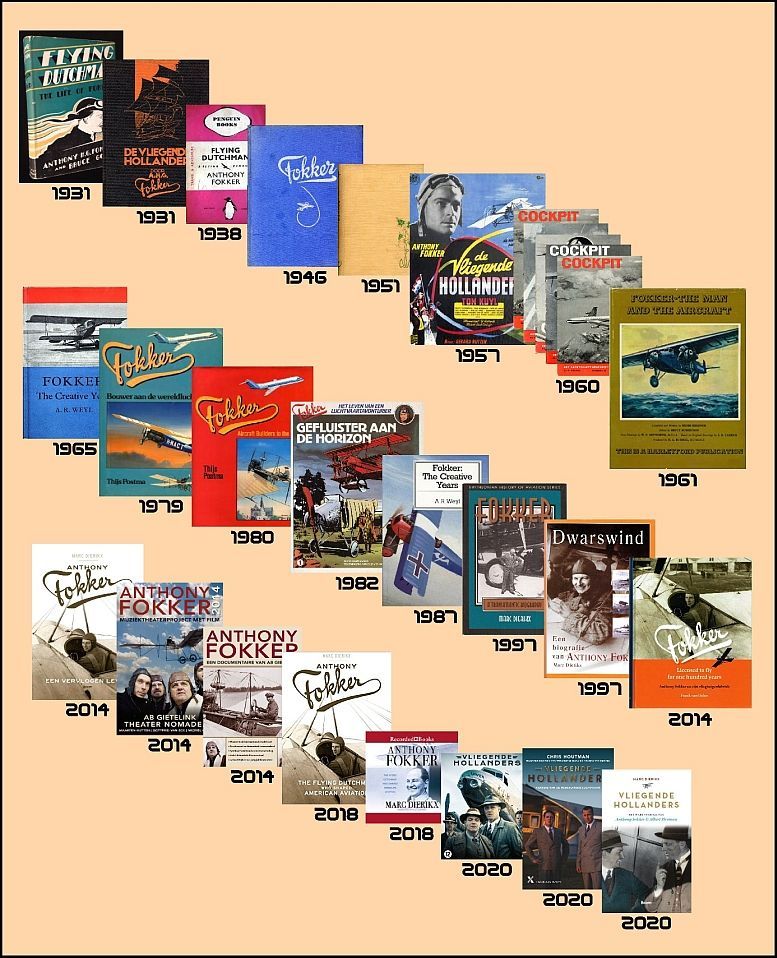
Fokker biographies have been written for many years.
The first, 'Flying Dutchman - The Life of Anthony Fokker', was an autobiography and was published in America in 1931. Fokker was then 41 years old and rather young to be looking back on his life.
But he was already world-famous and felt it was time for a retrospective of his career. Fokker, no linguist, left the writing to ghostwriter Bruce Gould, who patiently recorded and organized everything. Translations appeared in Dutch (The Flying Dutchman), French, German, Danish, Bulgarian, Portuguese, Swedish and Czech.
It soon became clear that Fokker had redacted his memories here and there; Bruce Gould had apparently not been instructed to verify Fokker's accounts.
Nevertheless, it remains The Flying Dutchman a fascinating account, illustrated with good photos. In 1938, a year before Fokker died, Flying Dutchman re-released, but now as a Penguin Pocket with the photos omitted.
Shortly after the Second World War, in 1946, Fokker: A life for aviation by Edmund Franquinet.
A hefty book that unfortunately offered little that was new - with the exception of the last chapter, which described the period after 1931.
The illustrations consisted of boyish-style drawings that now seem dated.
All in all a less penetrating biography than The Flying Dutchman.
Then came Fokker, his life and career by B. Graafland, published in 1951. Who read the two previous biographies Even those who knew him weren't much wiser from this compact book. It also contained some silly errors (for example: Dutch airspace was defended by the Fokker G-1 and G-2 in 1940). In short, this biography should be on every bookshelf.
In 1957 Fokker's life could be admired in the cinema (The Flying Dutchman), or at least his earliest years, with the 1911 Spin Demonstration above Haarlem as its finale. This feature film, starring Ton Kuyl, received poor reviews, attracted a small audience, and was quickly withdrawn from circulation. It can be found on YouTube.
In 1960 Hugo Hooftman published an illustrated serial in his magazine Cockpit called The life of Anthony Fokker.
After five promising episodes, this series was canceled for unknown reasons. Such a shame.
Then things got serious again. In 1961, Harleyford, a renowned British publisher, published a richly illustrated Fokker's book ('Fokker - The Man and the Aircraft'The author was Henri Hegener, a Dutch aviation journalist who had known Fokker well.
The title reflected the layout: first, an extensive biographical section (the Man), followed by a description of all the aircraft that have borne Fokker's name (the Aircraft). A good book without a doubt, and still highly recommended.
Shortly after, in 1965, Fokker: The Creative Years by Alfred Weyl. Just as interesting and well-developed as Hegener's book, but limited to the German years (1910-1919) and written from a more critical perspective.
Although the title suggests that Fokker was being hailed as a designer, the opposite was true: Weyl claimed that it was not Fokker himself, but his engineer Reinhold Platz who was the ultimate mastermind behind the legendary Dr.I and D.VII.
The Creative Years sold well and was reprinted in 1987 with a new dust jacket.
It was not until 1979 that it was time for a Dutch edition again. Fokker - Builder of World Aviation by writer/illustrator Thijs Postma was a pleasant book, but the title referred to the factory, not to the person himself.
There was a dash of biography, but it was mainly about the aircraft, including those designed after Fokker's death. An English translation appeared in 1980 ('Fokker - Aircraft builders to the world').
In 1982, Fokker's life story was made into a comic strip (Fokker - Whispers on the Horizon: The Life of an Aviation Adventurer). This album was funny but otherwise not very impressive.
The first real, in-depth biography did not appear until 1997: 'Fokker - A transatlantic biography', by historian and writer Marc Dierikx.
Drawing from numerous, often new sources, a well-researched story was told here in which Fokker took centre stage as a person, with his aircraft as a backdrop.
Each period of his life (1890-1939) was discussed in detail.
The Dutch translation, retitled as 'Crosswind, appeared later that same year.
In 2014 appeared 'Fokker - Licensed to fly for one hundred years' by Frank van Dalen.
Another journey through the time, but this time based on the technical innovations that once made Fokker a leader in the aircraft industry.
This beautifully illustrated engineering biography was intended exclusively for the staff of Fokker Technologies and was unfortunately never available for sale.
Also in 2014, Fokker's life became the subject of a theatre project, with creator Ab Gietelink playing the role of Fokker.
This performance, 'Anthony Fokker', was performed in numerous theaters, as well as in the hangars of Eelde, Beek, Teuge, Midden-Zeeland, and Oostwold. Gietelink also managed to collect historical film footage and compile it into a documentary ('Anthony Fokker') that covered Fokker's entire life. Interesting, because now we know how Anthony Fokker spoke and how he moved.
That same year, 2014, a second Fokker biography by Marc Dierikx was published ('Anthony Fokker - A Bygone LifeSo much new and surprising information had become available via the Internet that Dierikx decided not to update his earlier manuscript from 1997, but to rewrite it from scratch.
It has become a tasty book in which Fokker comes across as an unstoppable entrepreneur, but also as a nuisance.
'A bygone life' seemed to have become the ultimate, definitive Fokker biography, but nothing could be further from the truth: in 2018 Marc Dierikx presented the English version in New York, 'Anthony Fokker - The Flying Dutchman who shaped American Aviation'. Dierikx stumbled upon even more unfamiliar material in America, which he incorporated into this book. This book is therefore more comprehensive than the Dutch version. It was also available as an audiobook; over the course of 16 hours, American actor LJ Ganser read the entire book aloud with a warm voice.
There was more to come. In 2018, AVROTROS announced it would be making a television drama about Anthony Fokker and Albert Plesman, the founders of Dutch civil aviation. Flying Dutchmen to be named.
The series was to consist of eight 50-minute episodes. No expense or effort was spared, and the historic Fokker aircraft were represented by stunningly beautiful computer simulations. The lead roles were played by Fedja van Huêt as Fokker and Daan Schuurmans as Plesman. Unfortunately, the production company had been given the freedom to freely manipulate the historical facts to enhance the storyline.
The epic as told in Flying Dutchmen, broadcast in 2020 and subsequently released on DVD, is therefore partly made up of fabrications and misrepresentations. A real shame.
The television series was accompanied by two books, both Flying Dutchmen were called.
The first was written by Chris Houtman based on the screenplay of the television series of the same name.
This scenario therefore deviated considerably from Fokker's actual life, so we can hardly call Houtman's book a biography.
The second book, subtitled the true story, was written by Marc Dierikx. As a historian, he stuck closely to the facts, but anyone truly interested in the life of Anthony Fokker will benefit more from Dierikx's works from 2014 and 2018.
© René Demets
An earlier version of the above story appeared in 2018 in the KNvVL magazine All Clear.