Fokker G.2
This should have been our fighter cruiser for 1941-1942
The concept
It seems odd that Fokker immediately abandoned the double tail boom concept of the G.1.
In the blueprints and construction drawings of the G.2, more similarities could be found with TV and especially with T.IX.
The T.IX prototype of 1937 was actually designed for LA/KNIL and made its first flight on 11 September 1939.
It was a modern and very fast bomber for its time and also made entirely of metal.
However, the T.IX was never produced in series due to the threat of war in 1940.
The prototype of the T.IX was completely destroyed in the Fokker hangar during one of the bombings at Schiphol.
Fokker and LVA jointly decided that the characteristics of the partially tested T.IX and a certain existing stock of building materials could lead to faster production.
The aircraft manufacturer got to work with feverish haste and, above all, in the utmost secrecy.
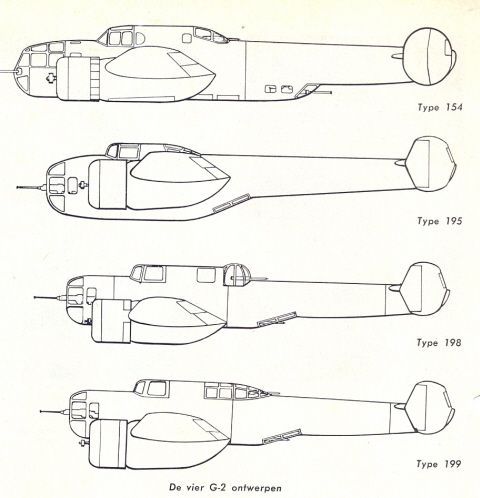
Four different designs of the G.2 were made, all of which had a number of similarities with the already proven T.IX.
On September 12, 1939, one day after the first flight of the T.IX prototype, Fokker already presented the four designs for the new G.2 fighter cruiser.
The designs 154-195 198 and 199 with the 154 as a starting point. (See image 01)
Possible engines
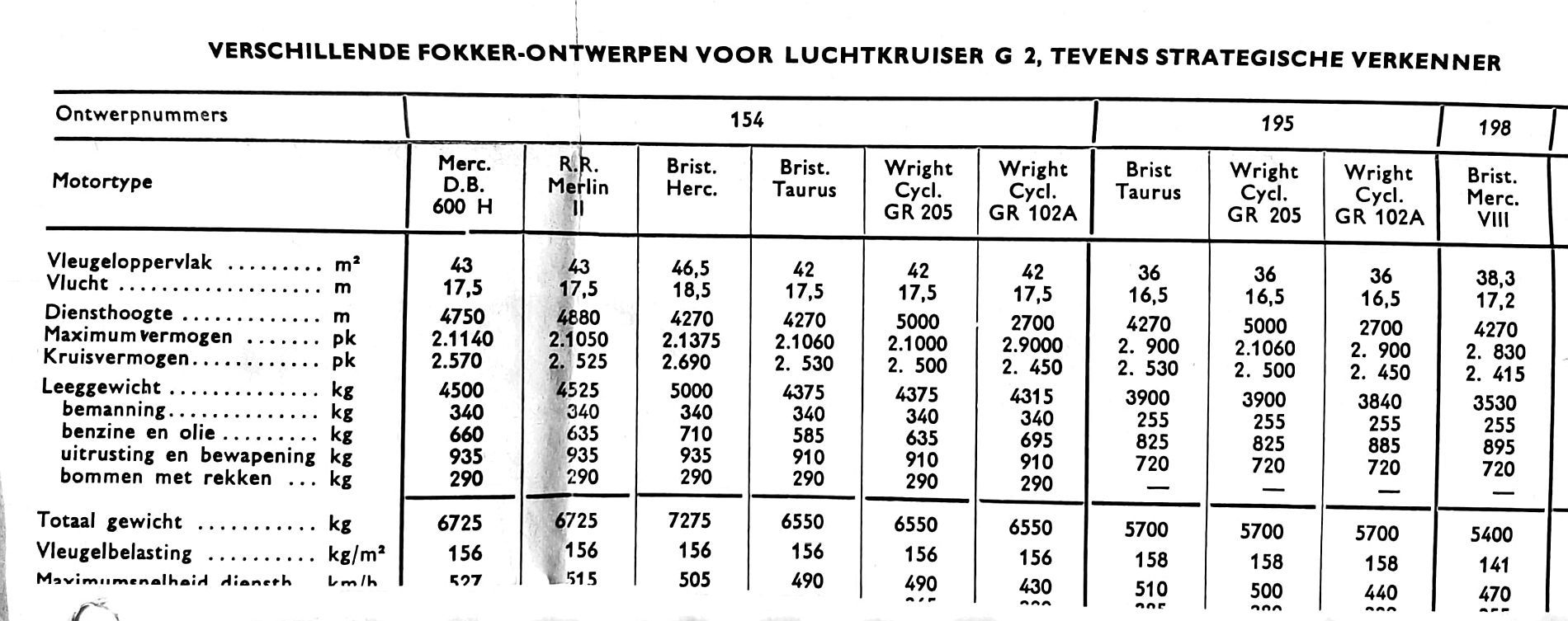
The engines used were the Rolls-Royce Merlin II, the Mercedes-Benz DB 600 and the Bristol Hercules and Taurus.
The American Wright Cyclone GR-1820-G102 was also considered, as the latter was already in stock in the Netherlands.
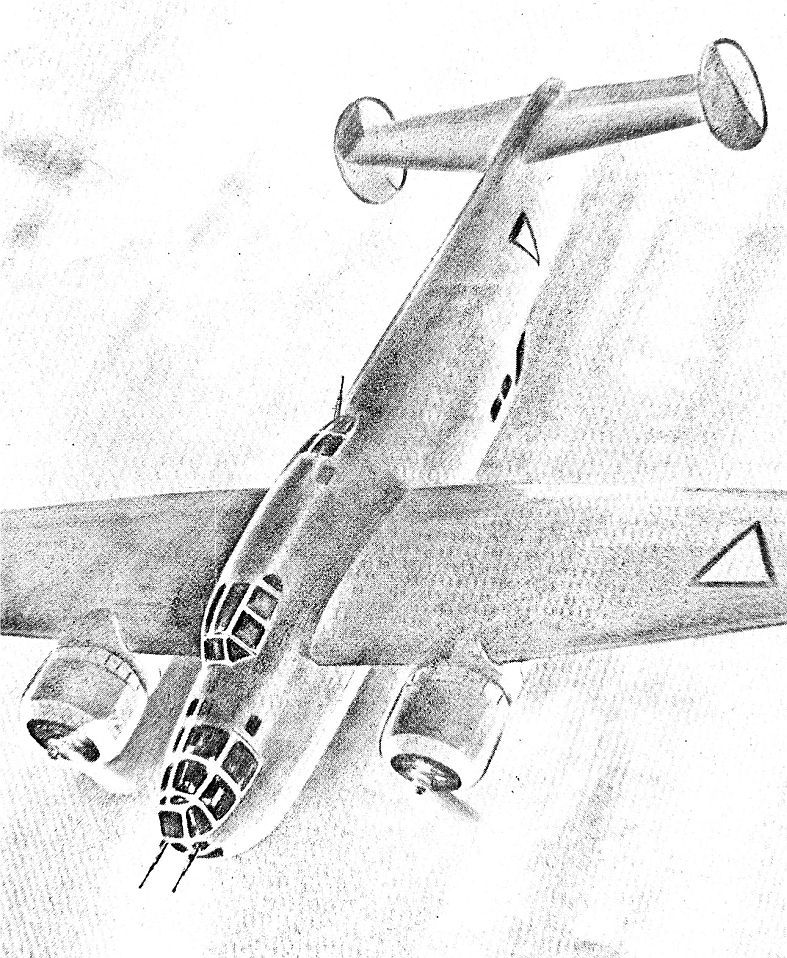
All in all, design 154 best met LVA's requirements in many respects.
Design 195 was more lightly armed than the 154 and the performance of the Bristol Taurus engine allowed for a higher speed of 510 km/h instead of 490 km/h.
When using the Wright Cyclone engine, performance was lower.
The importance of the shortest possible delivery time for the engine was a major concern, given the increasingly difficult international situation.
Rapid production capability
Fokker informed LVA that delivery of the prototype design 154 of the G.2 would be a fact eight months after confirmation of the order.
Unbelievable, we would say now, and what's more, after that delivery, two G.2s could be delivered every two weeks, up to a total of 20 units.
However, the starting point was that the main materials were at least available.
Fokker also claimed this speed was achievable for the Type 195, which was smaller and lighter.
So a further number of 36 aircraft to be delivered became a possibility.
Types 198 and 199 could also be delivered in 5.5 months at a rate of three per week.
The LVA studied the assignments and arrived at design 154, and after discussions with Fokker the decision was made on October 19, 1939.
The engine choice was provisionally made for the Mercedes-Benz DB 600 and the project involved the construction of twenty G.2 fighter cruisers.
The four fixed wing machine guns were dropped due to torsional problems in the wing.
The two movable guns in the fuselage nose were replaced by two coupled .30 caliber machine guns.
LVA insisted on ordering all parts and engines immediately.
All instruments remained the same as in the G.1 and all materials for the twenty ordered and five reserve fighter cruisers were ordered.
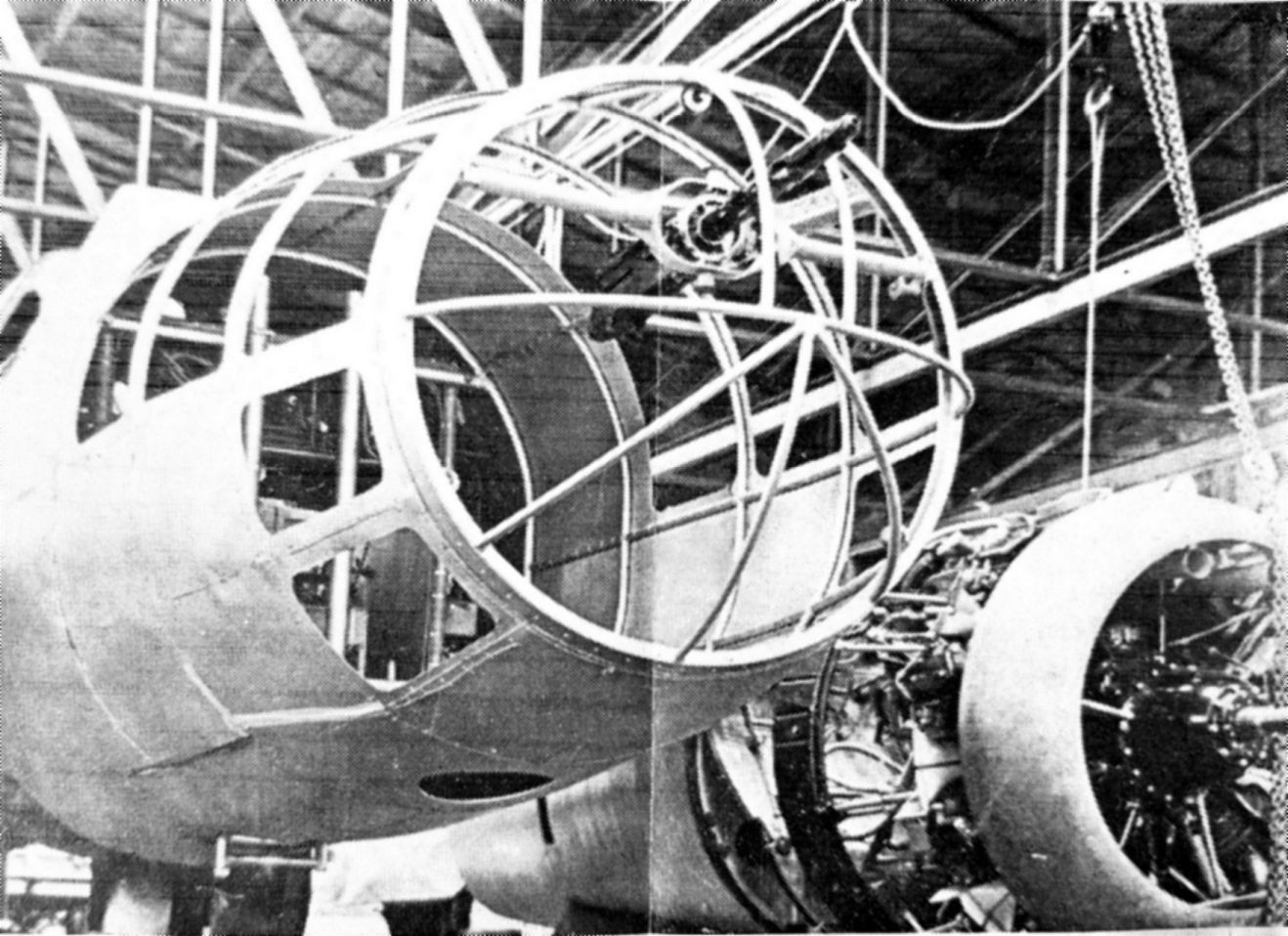
Work on the mock-up began immediately.
On November 6, 1939, the entire electrical installation was ordered and the bomb bay was designed for a load of 500 kg.
On November 30, 1939 it was decided to go for a four-seater version, and the steering became single rather than double.
On December 4, 1939, the radio installation and other technical details were recorded.
With NSF (Dutch Signal Equipment Factory in Hilversum) radio and technology were recorded on December 14, 1939.
Bomber and/or fighter cruiser and/or . . . .
The mock-up was ready as early as January 15, 1940 (See photo 03).
As a bomber, in addition to the 500 kg bomb load, an additional 500 kg fuel tank was fitted in the wing.
Also a 7.9mm M-36 FN machine gun at the front, rear, top and bottom.
For the fighter cruiser, the bomb load was reduced to 250 kg.
The front armament was one 20 mm cannon and four 7.9 mm FN machine guns, one aft-upper, one 20 mm cannon aft-lower.
The G.2 had to be able to do all sorts of things and also had to be able to stay in the air for around 3 hours.
A quick conversion from one function to another should also be possible.
That fuss, in the midst of approaching war, even led to the suggestion to rename the G.2 the C.16.
Promising but never flew
The blitzkrieg brought many developments to a swift end, including the Fokker G.2. The G.2 never reached the flying stage.
A promising project falls into oblivion and the outsider doesn't know what the G.2 should have become.
Therefore, this story is a tribute to a small group of men from LVA, Fokker, and all the other suppliers who put in so much feverish, hard work between September 1939 and May 1940.
Click on the photo to enlarge the photo