The Fokker V.7
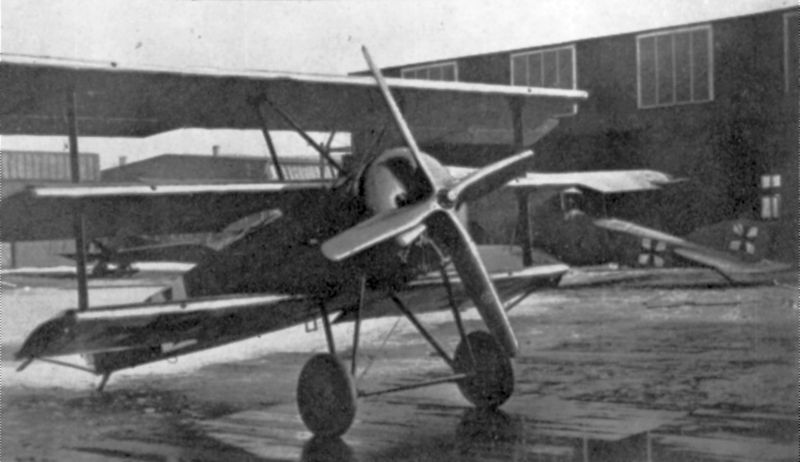
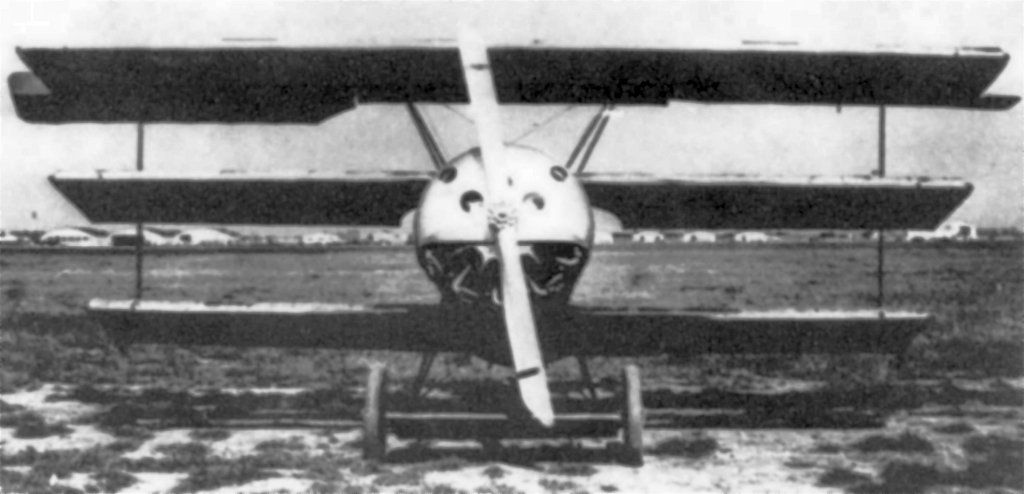
The Fokker V.7 was a prototype. It was an attempt to improve the Dr.I by using the experimental Siemens-Halske Sh.III, double-acting rotary engine.
In a double-acting rotary engine, the crankshaft turns in one direction while the crankcase turns in the other direction*.
To take advantage of the increased power and speed, the aircraft featured a four-bladed propeller with a larger diameter compared to the Dr.I.
The larger propeller diameter in turn required a higher landing gear.
The fuselage behind the cockpit had to be extended to compensate for the weight of the heavier engine.
Four V.7 aircraft were built:
- The V.7/I took part in the fighter competition of January 1918.
The performance of the V.7 was excellent, but the engine was not ready for use.
The Fokker V.7/I was converted into a Dr.I.
- The V.7/II was powered by a 160 hp Gnome engine.
- The V.7/III used the 170 hp Goebel Goe.III, and although its performance was excellent, the Goe.III was no more battle-ready than the Siemen-Halske.III of the V.7/I.
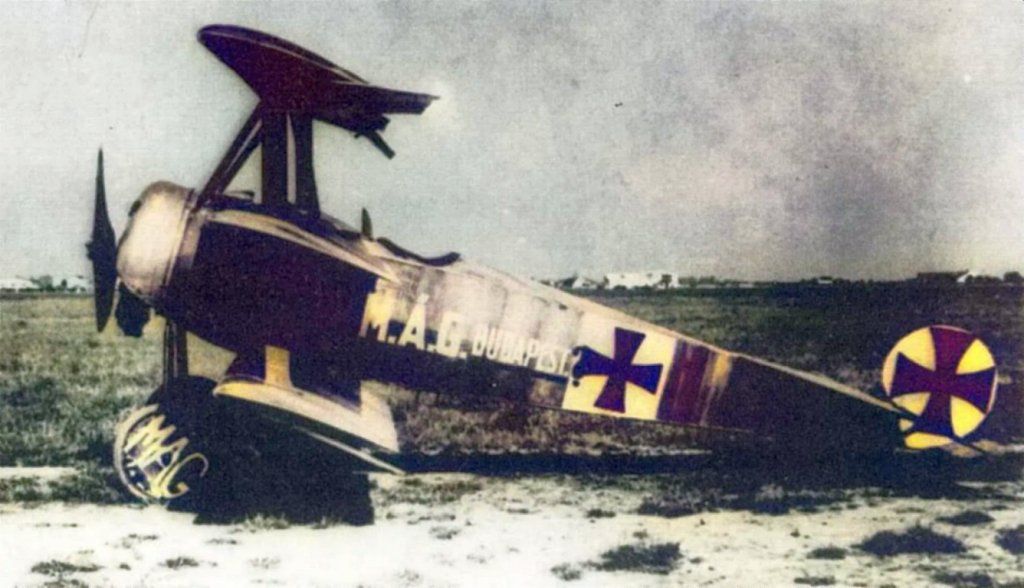
- The V.7/IV was delivered without an engine to the MAG company in Austria-Hungary.
MAG has equipped it with a 145 hp Steyr rotary engine.
The aircraft was intended to take part in the Austro-Hungarian fighter competition in July 1918, but damage from a crash on landing caused it to miss the competition.
*One of the problems with a rotary engine is that the rotating mass of the cylinders creates a gyroscopic torque.
This torque creates 'strange' forces when the pilot makes a turn or climbs or descends.
By rotating a mass (the crankcase) in the opposite direction, the gyroscopic torque is (partially) compensated.
Click on the photo to enlarge the photo